“Had a tall spruce leaning right over the back of the house. He walked the lot, showed me the root plate was already lifting, and took it down in sections without touching the roof. Clean job, no mess left behind.”
“After the last windstorm I was worried about the firs along the property line. He checked each one, told me two were fine and one had to go. I appreciated that he did not try to sell me more than I needed.”
“He pruned the big spruce near the driveway so the branches were not scraping the truck. Explained what he was cutting and why, and left the lower limbs clear. Fair price and he showed up when he said he would.”
“He removed a fir that had come down in a storm and ground the stump below grade so I could seed grass over it. Brought his own chipper and hauled everything away. Straightforward guy, easy to deal with.”
Tree Disease Treatment in Mispec

When a spruce or fir on a rural lot in Mispec starts dropping needles early, oozing from the bark or dying back at the top, the cause is not always obvious. I walk the whole property before I touch a saw: needles and bark, roots and soil. Along this stretch of coast southeast of the city, trees deal with salt spray off the bay, thin soil over rock and wet springs on top of the usual diseases. What looks like a fungus can be salt burn or poor drainage, and what looks like decline from the top down can be a root problem hidden under the moss. I check the tall spruce and fir around homes here for windthrow risk at the same time, because a tree weakened by disease or decay loses its grip in a blow off the water.
Some problems respond to pruning and better care: I remove the infected limbs, open the crown to light and air, and clear the brush so the ground can dry. Others need treatment, and some trees are better replaced, especially where the soil is too shallow over rock to support a healthy root system. I will tell you which is which. On these lots, access matters as much as diagnosis: I plan around the gate, the driveway and the slope before I bring the chipper in, and I clear the tall spruce and fir that lean toward a house. I document what I find so you have a clear record of the tree's condition.
You get an honest walk-through of the options, no pressure to cut what can be saved, and a free estimate before any work starts. If a tree on your Mispec property is ailing, call The Saint John Arborist at (506) 719-9104 for a free estimate.
Tree Trimming in Mispec, Done Right

Mispec stretches out along the coast south-east of the city in rural lots, and the trees here reflect that: tall spruce and fir standing close to homes, often within a few metres of a roofline or a driveway. When I walk a Mispec property, I am looking at two things at once. First, the branches that are already a problem: limbs crossing over a roof, a low bough scraping a vehicle, a spruce leader leaning toward a fence. Second, the windthrow risk. Those tall evergreens hold a lot of sail area, and when a nor'easter comes off the water, a tree that has grown top-heavy or lost its balance is the one that comes down. Trimming is how I take that pressure off before a storm does it for you.
My work on these trees is deliberate. I remove crossing and low limbs, lift the crown where you need clearance over a driveway or walkway, and shape the tree so it stays balanced through our coastal winds and heavy wet snow. What I will not do is top a tree or strip the inside of the canopy. A tree I have trimmed should still look like itself, and Mispec's spruce and fir do not respond well to being cut back hard. I climb it myself, lower anything heavy by rope so it does not land on a roof or a fence, and I clean up before I leave. The estimate is free, and I will tell you honestly if a tree only needs a light trim rather than a major cut.
Access on these rural lots varies a lot, so I plan the job around your gate, your driveway and where my chipper can safely sit. If you have spruce or fir crowding a home in Mispec, or a maple that has outgrown the yard, call (506) 719-9104 for a free estimate.
Tree Removal in Mispec, Done Section by Section

In Mispec, the lots are rural and the coast runs south-east of the city, so the trees I take down here are mostly tall spruce and fir standing close to homes. Those are the ones that worry me: a spruce with a shallow root plate on a rocky lot, a fir that has started to lean after a windstorm, or a stem split by a storm and hung up in a neighbour's branches. Before I cut anything, I look at the lean, the root flare, the soil and what the tree would hit if it went the wrong way. On these coastal lots, the windthrow risk is real, and checking for it is part of the job, not an extra.
I take trees down in sections, working from the top with ropes and rigging, so each piece is lowered exactly where I want it. That matters in Mispec, where backyards are tight, the ground is rocky and uneven, and there is often no room to drop a full stem. I climb it myself, set my rigging, and lower the wood piece by piece. Before the saw goes in, I check whether the tree sits on City property or is tied to a development, because those cases follow their own rules in Saint John, and a removal may need a permit. Once the tree is down, I chip the brush and either haul the wood away or cut it to length for you, whichever you prefer.
If you have a spruce leaning toward the house or a fir that a storm has split, call me at (506) 719-9104 for a free estimate. I will tell you honestly whether it needs to come down or whether it can stay.
Cedar Hedge Trimming in Mispec
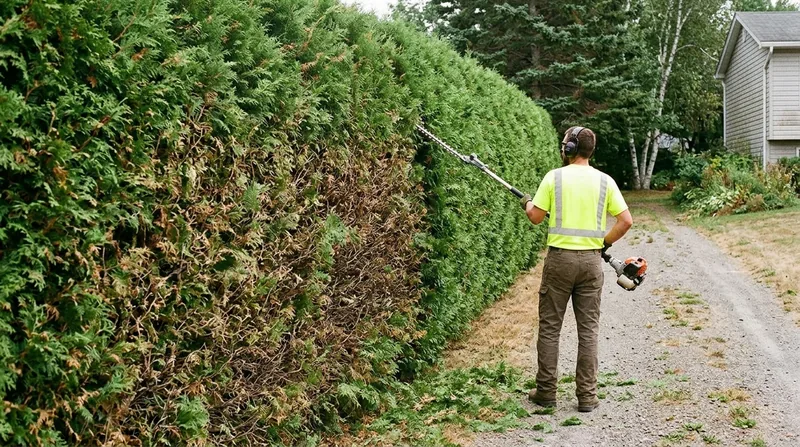
Cedar hedges in Mispec take a beating that inland gardens never see. The lots here run long and narrow toward the water, and the wind comes off the bay with nothing to slow it down. Salt spray burns the outer tips, snow load bends the tops over through the freeze-thaw, and by spring the hedge has brown pockets and a lean. I trim the sides flat and take the top slightly narrower, so sunlight reaches the bottom branches and the foliage stays green all the way down instead of going bare and woody at the base.
Most of the hedges I see in Mispec were left a season too long. When a cedar has grown wild, I don't cut it back to bare wood in one pass, because cedar will not regrow from it. I bring it down over two or three seasons, taking a little each time, and I clean out the dead patches that winter burn and snow loads leave behind. The tall spruce and fir standing close to the houses on these rural lots get checked at the same time for windthrow risk, since a saturated nor'easter can push one over onto a roof.
Access matters on the coast roads southeast of the city. Some driveways are narrow and some properties have a gate I have to fit my equipment through, so I look at that before I quote anything. All clippings are collected and taken away, and I leave the ground clean. I'm local and fully insured, and I'll give you a free estimate on the spot. Call (506) 719-9104 and I'll come look at your hedge.
Stump Grinding in Mispec, Done Right

Mispec is a stretch of rural lots along the coast south-east of the city, and the trees here tell you what kind of ground you are on: tall spruce and fir, close together, holding the wind. When I take one of those down for a homeowner, the stump does not disappear with the trunk. It stays in the lawn as a trip hazard, a mower breaker and a home for insects, and on these lots it is often sitting in rough grass where nobody sees it until a foot finds it. I grind stumps below grade with a compact machine that fits through a standard gate, so I do not have to tear up your yard to reach the back of the property.
I grind out the surface roots around the stump too, because on the coast the spruce roots run wide and shallow and they will dull a mower blade long after the stump itself is gone. Then I leave the chips to fill the hole or haul them away, whichever you prefer. If you plan to plant a new tree, lay sod or build in the same spot, tell me before I start and I will go deeper and clean the area more thoroughly. On these wind-exposed lots I also check the standing spruce and fir around the house for windthrow risk while I am there, since a tree leaning after a blow is worth knowing about.
Access matters out here. Some properties sit behind a narrow lane or a gate, and the compact grinder is the reason I can still get to the back without chewing up the drive. The estimate is free, so call me at (506) 719-9104 and I will come look at the stump and the ground around it.
Mispec, as the arborist sees it
At Mispec, the lots run out to the coast south-east of Saint John, and the trees tell you the wind story before you even step out of the truck. Tall spruce and fir stand shoulder to shoulder on these rural properties, their tops leaning inland from years of salt air and prevailing weather. I walk these lots through every season, and what I look for changes with the calendar: in spring, the frost-heaved ground around root plates; in summer, the dead tops that only show once the needles thin; in fall, the first signs of windthrow where a root plate has started to lift; in winter, the lean that wasn't there last year. A spruce that has grown up in a sheltered stand often has a shallow root system, and when the wind gets at it, the whole tree can go over. That is why I check the ones closest to the house first, then work outward. The work here is not the same as in a tight city yard: the lots are wider, the trees are taller, and the drop areas are longer, so I plan each cut with more room and more attention to what is underneath.
Most of what I do in Mispec is clearing those tall spruce and fir away from homes, and checking them for windthrow risk. Sometimes that means taking a tree down because it is already compromised; sometimes it means cabling or bracing one that is worth keeping. I would rather tell you a tree can stay than sell you a removal you do not need. If you are on one of the rural lots along this coast and you have a spruce leaning toward the roof, or a fir that has started to show a dead top, call me at (506) 719-9104 and I will come out for a free estimate. I document what I find so you have a clear picture of the risk, and if the City of Saint John may require a permit for a private tree removal, I will tell you that up front and an arborist report can support the application.