“I had two big maples by the water that were rubbing together and dropping limbs every windstorm. He climbed both, cleaned out the deadwood and thinned the crowns so the wind passes through. No fuss, no mess left behind.”
“One of my spruce had died near the house and I was worried about it coming down on the roof. He came out, gave me a free estimate, and took it down in sections with a rope. Clean job, and he chipped the brush.”
“After a storm took out an old birch, I was left with a stump right in the middle of the lawn. He ground it below grade and hauled the grindings away. You cannot tell there was ever a tree there.”
“My cedar hedge had grown out of shape and was blocking the path. He trimmed it back evenly and cleaned up the clippings. It looks sharp now, and he told me how to keep it that way.”
Tree Disease Treatment in Renforth

When a tree in Renforth starts dropping leaves early, oozing from the bark or dying back at the top, the cause is not always obvious. I look at the whole picture, from leaves and bark down to roots and soil. Here by the water, trees deal with salt spray off the river, thin soil over rock and wet springs on top of the usual diseases. I prune mature hardwoods and spruce along these lots so they shed the wind coming off the river, and I have learned to read what the shoreline does to them. Some problems come from a fungus or decay, others from salt, wind or poor drainage, and the two get confused all the time.
That is why I start with a walk-through rather than a spray schedule. I check the crown for dieback, peel back a little bark where it looks suspicious, and look at how water sits on your ground after a wet week. Some trees respond to pruning and better care, others need treatment, and some are better replaced. I will tell you which is which, including when the honest answer is to leave a healthy tree alone. If a removal is unavoidable, the City of Saint John may require a permit for a private tree removal, and an arborist report supports that application.
Call (506) 719-9104 and I will come out, look at your trees and walk you through the options. The estimate is free.
Tree Trimming in Renforth, Done Right

In Renforth, I trim trees by the water, where the wind comes off the river and hits the hardwoods and spruce head-on. The lots here are a mix: mature maples and oaks in the older yards, spruce and cedar closer to the shore, and the odd birch that has leaned a little too far over a driveway after a wet snow. I climb each tree myself, from the first cut to the last rake, and I take the time to read how it has grown against the wind before I touch a branch.
Most calls in Renforth start the same way: limbs over a roof, a driveway, or a neighbour's fence, or a maple that has simply outgrown the yard. I remove crossing and low limbs, lift the crown where you need clearance, and shape the tree so it stays balanced through our coastal winds and heavy wet snow. I do not top trees and I do not strip the inside of the canopy. A tree I have trimmed should still look like itself. Anything heavy comes down by rope, and I clean up before I leave.
Access matters here. Some properties sit tight against the water with narrow drives, and I plan the work around the gate my chipper fits through and the space I have to drop brush. If a tree is close to your private service entrance, I keep the proper approach distance from the wire and work only on your side of it. The estimate is free, so call (506) 719-9104 and I will come out to Renforth to look at your trees.
Tree Removal in Renforth, Done Section by Section

In Renforth, the lots run down toward the water and the wind comes off the river with nothing to slow it. When a tree has to come down here, it is rarely a clean open drop. I am often working between a house, a shed, a fence line and the shoreline, on ground that is part rock and part fill. I take the tree down in sections, from the top, with ropes and rigging, so every piece is lowered exactly where I want it. Nothing gets felled blind onto a rocky lot or into a tight backyard.
Before I cut, I look at what I am dealing with. Mature hardwoods and spruce are the usual mix along these streets, and spruce in particular can look sound from the ground while the base is not. A dead ash or a storm-split trunk changes the plan entirely, and I will tell you if the tree does not actually need to come down. I also check whether the tree sits on City property or is tied to a development, because those cases have their own rules in Saint John, and a removal on private land may need a permit. I would rather sort that out before the saw comes out than after.
Once the tree is on the ground, I chip the brush and either haul the wood away or cut it to length and stack it for you. I am a local, fully insured operator, and I document what I find so you have a record if you need one. If you have a tree in Renforth that is leaning, dead or already broken, call (506) 719-9104 and I will come out for a free estimate.
Cedar Hedge Trimming in Renforth
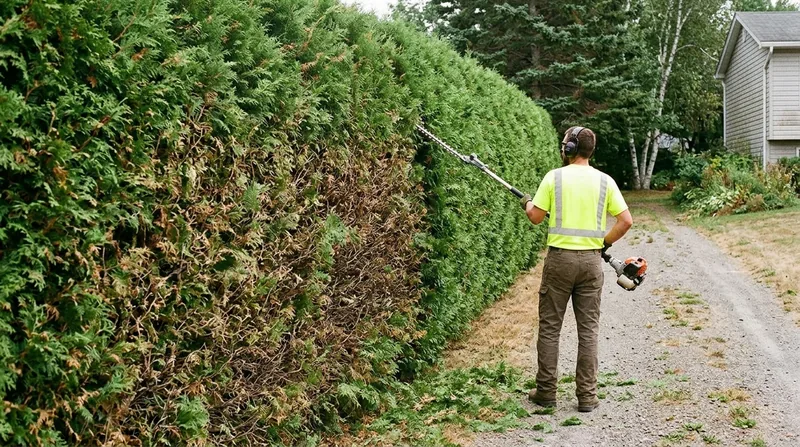
In Renforth, most properties sit close to the water, and the cedar hedges along those lots take a beating. Wind coming off the river pushes salt and cold through the foliage all winter, and snow loads bend the tops over. When I walk a Renforth yard, I look for the two things that tell me a hedge has been left too long: bare brown wood low on the sides, and a top that has spread wider than the base. That shape is the problem. If the top is the widest part, it shades the bottom, and the bottom goes brown and stays that way.
My approach is to trim the sides flat and keep the top slightly narrower than the base, so sunlight reaches the lowest branches and the hedge stays green all the way down. On a hedge that has grown wild, I do not try to fix it in one visit. I bring it back over two or three seasons, taking a little at a time, because cedar will not regrow from bare wood. Cutting hard into the brown interior leaves a permanent gap. I also clean out the dead patches that winter burn and heavy snow leave behind, and I shape around gates, driveways and the narrow side yards common on these lots. All clippings go into the chipper and leave with me.
If your hedge has gotten away from you, or you simply want it brought back to a clean line before the season turns, call me at (506) 719-9104 and I will give you a free estimate on the spot.
Stump Grinding in Renforth, Done Right

In Renforth, the lots near the water tend to be tight, and the back gardens are often reached through a narrow gate between the house and the fence. That is exactly why I run a compact grinder: it fits through a standard gate, so I can reach a stump behind the shed or along the shoreline without dragging equipment across your lawn or pulling down a fence panel. A stump left sitting in that grass is a trip hazard for the kids, a hard stop for the mower blade, and a slow nursery for insects. I take it out below grade, not just flush with the soil.
I also grind out the surface roots that spread from the base, because those are what heave a patio or catch a mower deck a season later. You choose what happens to the chips: I can leave them to fill the hole, or haul them away. Tell me up front if you plan to plant a replacement tree, lay sod, or build on that spot, and I will grind deeper and clean the area more thoroughly so the new work has something solid to sit on. Around Renforth I am often working near mature hardwoods and spruce, and the roots on those older trees can run wider than people expect, so I check the grade before I start.
I am a local, fully insured owner-operator, and I would rather look at the stump than guess over the phone. The estimate is free. Call (506) 719-9104 and I will come out to Renforth, look at the access and the roots, and tell you honestly what the job needs.
Renforth, as the arborist sees it
I work the lots in Renforth where the streets run down toward the water and the wind comes off the river with nothing to stop it. The properties here are older, with mature hardwoods and spruce that have been standing through decades of ice storms and freeze-thaw cycles. When I walk a yard in spring, I look at the leaders on the spruce and the included bark on the maples; by summer, I am checking the canopy for deadwood that the winter loosened. The work is particular because the wind exposure is constant: a tree that leans out over the water needs proper reduction pruning, not a hard cut, or the next blow takes it down. In fall, I am clearing storm damage and grinding stumps before the ground freezes, and in winter I am cabling and bracing the older hardwoods that frame the views. I climb these trees myself and chip the brush on site, and I keep my approach simple: prune for wind resistance, remove what is dead, and leave the rest alone.