“My spruce windbreak was so thick you could not walk between the trees. He thinned it out, took the weak ones, and cleaned up every branch. The yard looks open now and the wind does not push on it the same way.”
“The big maple over the driveway was dropping limbs on the car. He pruned it back properly, explained why he was not taking more, and left the lawn cleaner than he found it. Fair and straight with me.”
“A dead birch was leaning toward the shed. He took it down in sections, nothing dropped where it should not, and he chipped the brush. I did not have to touch a thing after he left.”
“He trimmed the cedar hedge along the lane and shaped it without scalping the sides. Told me to wait a bit longer next time so it fills in better. That is the kind of advice I trust.”
Cedar Hedge Trimming in Nauwigewauk
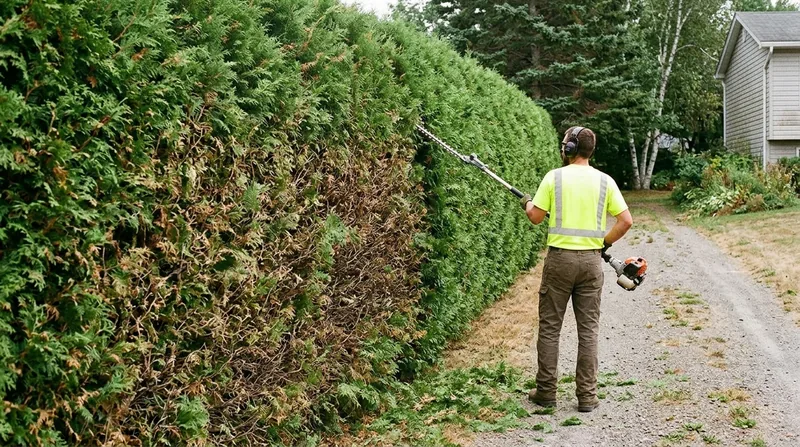
I trim a lot of cedar hedges between Quispamsis and Hampton, and the ones at Nauwigewauk have their own character. This is farm country, so I get called out to windbreaks along property lines and big yard trees around buildings, often on lots where the ground dips and the wind comes across open fields. The hedges here take a beating: snow load off the roofline, winter burn on the exposed side, and a summer season that pushes growth faster than most owners can keep up with. When I pull up, I look at the whole run before I touch a blade, because a hedge left a season too long reads very differently up close than it does from the road.
My method is simple and it is the same on every property. I trim the sides flat and keep the top slightly narrower than the base, so sunlight reaches the bottom and the hedge stays green all the way down instead of going bare at the skirt. If yours has grown wild, I bring it back over two or three seasons rather than cutting into bare wood, because cedar will not regrow from it. I also clean out the brown, dead patches that winter burn and snow loads leave behind, and I collect every clipping and take it away with me. I clean up every branch before I leave, and that includes the trimmings that fall into the field or against the barn.
Access matters on these properties, so I plan the job around your lane, your gate and where I can safely set up. If you want to know what your hedge needs, I will give you a free estimate on the spot. Call (506) 719-9104 and I will come take a look.
Stump Grinding in Nauwigewauk Yards

When I pull into Nauwigewauk, I am usually looking at a yard that has seen a few generations of use: a farm windbreak along the property line, a big maple or spruce shading the house, and an old stump or two left over from a tree that came down years ago. Those stumps are worth dealing with. A stump in the lawn is a trip hazard for anyone walking the property at dusk, it stops a mower deck cold, and it gives insects and rot a place to settle in close to the buildings. In this stretch between Quispamsis and Hampton, lots tend to be generous, but the working space around a house or barn is often tighter than it looks, with fences, sheds and mature trees crowding the approach.
That is why I grind stumps with a compact machine that fits through a standard gate. I would rather walk the grinder in than tear up a lawn or pull a fence panel to reach a stump at the back of the lot. I grind below grade, and I take out the surface roots around the stump too, so the area is safe to walk and ready to mow again. You choose what happens to the chips: I can leave them to fill the hole, or haul them away. If you plan to plant a new tree, lay sod or build on that same spot, tell me before I start. In that case I go deeper and clean the area more thoroughly, because a half-removed root system will interfere with whatever goes in next. I also thin farm windbreaks and clean up around big yard trees, and I do not leave a job until every branch and bit of debris is picked up.
Nauwigewauk properties often sit on heavier soil that holds moisture, so I pay attention to how the ground drains before I bring the machine in, and I keep off soft spots where tracks would leave ruts. If you have a stump that has been in the way for years, call me at (506) 719-9104 for a free estimate.
Tree Pruning in Nauwigewauk, New Brunswick

Pruning in Nauwigewauk is not the same job as pruning in a dense city core, and I treat it that way. The lots between Quispamsis and Hampton are mostly a mix of farm windbreaks and large yard trees standing close to buildings, and the wind that comes off the bay hits them hard. I thin those windbreak rows so air moves through instead of pushing the whole line over, and I look at every big yard tree with the house, the shed and the driveway in mind. Most of the work here is spruce, cedar, maple, birch and the occasional old oak, and each one tells me something different about how it wants to be cut.
My pruning is about the tree's health more than its looks. I remove deadwood, rubbing branches and weak forks that tend to fail in the big post-tropical storms we get off the bay, and I train young trees early so they grow a strong frame instead of a future problem. After Dorian and Lee took down big trees right in the middle of the city, I look closely at every union and every lean before I cut. For most trees, late fall through early spring is my preferred window, when the sap is down and the structure is easy to read. I explain every cut before I make it, and I clean up every branch before I leave, so the yard is as tidy as I found it.
Access matters on these properties. Farm lanes, fence lines and tight space between buildings mean I plan how the chipper and the truck get in before I start, and I work around wells, septic beds and buried lines. If you have a windbreak that has gone shaggy or a yard tree that worries you, call me at (506) 719-9104 for a free estimate and I will tell you honestly what the tree needs.
Tree Cabling and Bracing in Nauwigewauk

Nauwigewauk sits between Quispamsis and Hampton, and the trees I work on there tell you what kind of ground it is: farm windbreaks running along field edges, and big yard trees planted close to barns, sheds and houses. Those old windbreak lines are usually spruce or cedar, and the yard trees are often maple, oak or birch that have been standing in the same spot for a long time. A lot of them carry a weak fork or a narrow union where two leaders grew out of the same point, and that is exactly the kind of tree I look at for cabling.
When a tree you love has a weak fork or a split limb but is otherwise healthy, cabling can buy it many more years. I climb the tree myself, check the union and the wood around it, and install flexible cables high in the crown so the limbs share the load in wind, snow and ice. Where a split has already opened, I add steel bracing rods. Access matters here: some of these yards sit back from the road behind a fence line or a narrow lane, so I plan where the truck and chipper go before I start, and I clean up every branch before I leave. Cabling supports a tree; it does not fix rot, so if the inspection shows the wood is too far gone, I will tell you honestly and we will talk about removal instead. I check my installations over time, and estimates are free.
If you have a windbreak tree leaning after a winter storm, or a yard maple with a crack you can see from the kitchen window, call me at (506) 719-9104 and I will come out for a free estimate.
Nauwigewauk, as the arborist sees it
I work the stretch of country between Quispamsis and Hampton, and Nauwigewauk sits right in the middle of it. It is farmland and big rural lots, with houses set back from the road and windbreaks running along the field edges. The trees here are mostly the ones people planted for a reason: spruce and cedar for shelter, maple and oak for shade around the buildings, and birch in the wetter corners. When I drive through on a spring morning, I look at the windbreaks first, because that is where the work usually is. A row of spruce that has not been thinned in years gets dense and top-heavy, and the first heavy windstorm takes the weakest ones down across the yard. Around the houses, the big maples and oaks need pruning for clearance over the roof and the driveway, and the cedars need a proper trim to keep their shape without shearing them into a wall.
What makes this area particular is the mix: open field on one side, mature yard trees on the other, and a lot of buildings tucked in between. I thin farm windbreaks so the remaining trees have room to move in the wind, and I prune the big yard trees around the buildings with the roof and the hydro service entrance in mind. I do not touch the public lines; that is NB Power's work. My job is the private service wire from the pole to your house, and I keep my distance. Every branch gets cleaned up before I leave, and I mean every one, because on a farm you notice what is left on the grass. If you are between Quispamsis and Hampton and you have a windbreak that has gone shaggy or a yard tree that has outgrown its space, call me at (506) 719-9104 for a free estimate.